
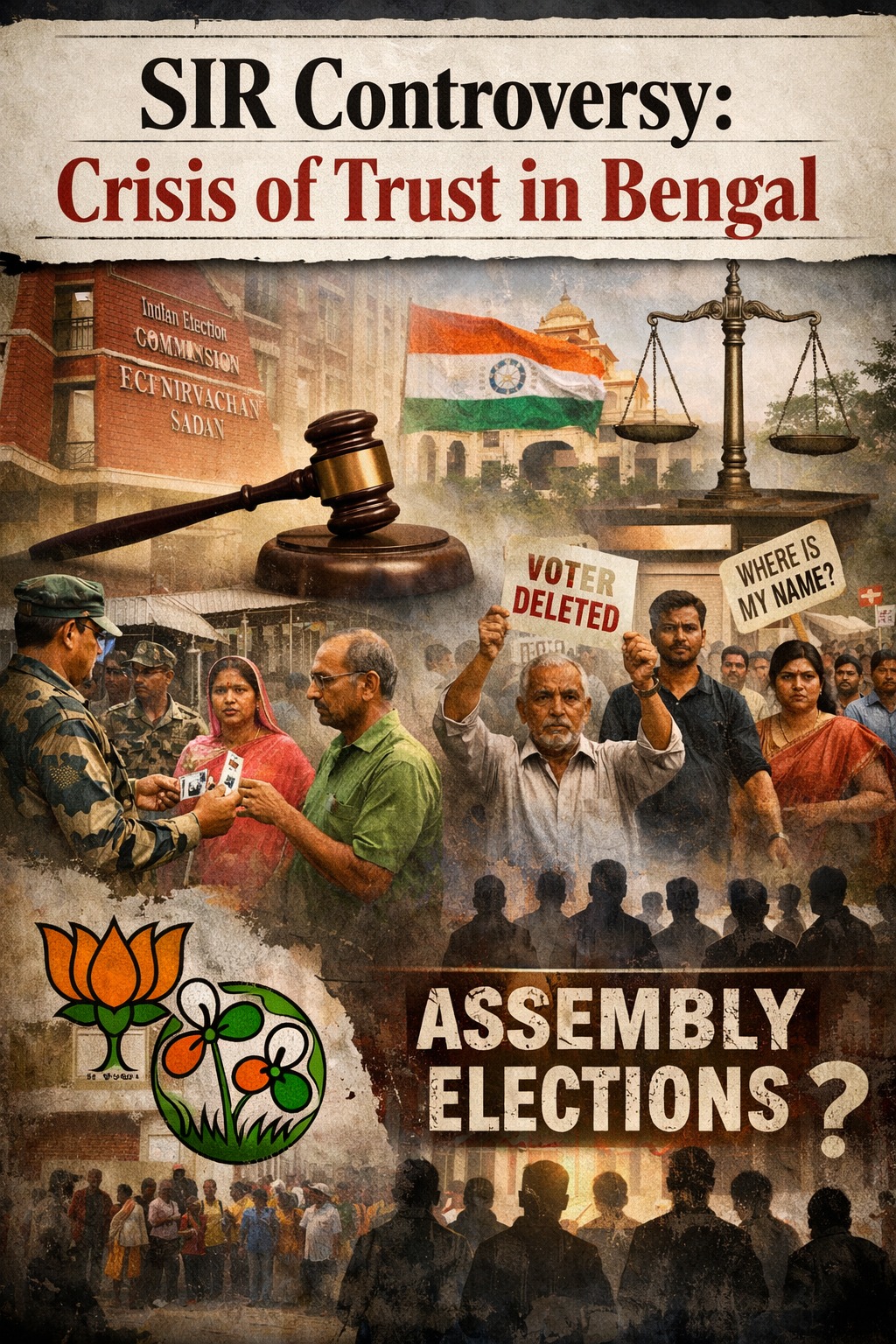
By Rafique Anwar : The controversy surrounding the Special Intensive Revision (SIR) in West Bengal is likely to have a clear impact on several constituencies in the upcoming Assembly elections. To understand this impact, a constituency-wise analysis is crucial, as the demographic structure, political history, and current ground reality of each region differ significantly.
Impact on Key Constituencies
Basirhat (North 24 Parganas)
A border constituency where both Muslim voters and the Matua/Refugee communities play a pivotal role. Due to SIR, complaints have surfaced regarding genuine voters being left out due to documentation issues. This allows the BJP to polarize votes by highlighting border and infiltration issues. Conversely, the TMC faces a threat if minority participation decreases. Basirhat remains a highly volatile seat where a minor vote swing could alter the result.
Jorasanko (North Kolkata)
A densely populated area with a significant population of Muslims, traders, and migrants. Allegations suggest a trend of large-scale voter deletion here. In such urban pockets, tenants and temporary residents are at higher risk due to lack of permanent documentation. While traditionally a TMC stronghold, the party could face direct losses if a large section is disenfranchised. However, the TMC might counter this by generating a ‘sympathy wave’ by labeling the issue as ‘deprivation.’
Domkal (Murshidabad
A minority-dominated constituency and a long-standing TMC bastion. Under SIR, mass deletion of voters is the most common grievance here. While this could directly hit the TMC’s vote bank, a counter-effect is possible: an atmosphere of fear might consolidate minority voters to turn out in larger numbers, ultimately benefiting the TMC.
Chowringhee (Kolkata)
A mix of upper-class, middle-class, and slum dwellers. In such urban constituencies, ‘data mismatch’ or change of address leads to frequent errors. SIR puts slum dwellers and migrants at risk, potentially denting the TMC’s urban base. On the other hand, the BJP expects marginal gains, making the seat more competitive than before.
Malda Region
Traditionally dominated by the Congress and TMC. The trend of missing voters in this district suggests that if the opposition vote splits and the specific voter share decreases, the BJP could stand to benefit indirectly.
Is the Electoral Process Reflecting a Crisis of Trust?
The SIR controversy is not merely a disagreement over an administrative procedure; it is raising fundamental questions about trust, transparency, and fairness in a democracy.
The Election Commission of India (ECI) is a constitutional body meant to be a neutral observer. However, when allegations of bias arise, the concern isn’t just about one decision—it is about the erosion of faith in the entire system. If citizens believe the ‘electoral referee’ is partisan, it poses a long-term danger to democratic health.
The ‘judicialization of politics’ is also evident as these disputes move to the High Courts and the Supreme Court. Furthermore, the gap between official data and ‘ground reality’—where the ECI claims procedural correctness while citizens claim disenfranchisement—highlights a failure in the grievance redressal system.
A Battle for Credibility
Ultimately, the SIR debate in West Bengal has evolved into a larger battle over the credibility of free and fair elections. While the ECI maintains that this is a ‘cleansing exercise’ to remove duplicate or ineligible names, the lived experience of many voters tells a different story.
In a country like India, where the poor, migrants, and marginalized often lack perfect documentation, a rigid verification process can
unintentionally lead to mass disenfranchisement.
Democracy does not run on institutions alone; it runs on trust.* Once that trust is lost, it is incredibly difficult to regain. The SIR controversy serves as a reminder that transparency, accountability, and unconditional respect for every citizen’s right to vote are the only ways forward.